If you are moving to Paraguay with a family, your biggest anxiety isn’t likely banking or safety. It’s schools.
Finding the right educational environment for your child in a new country, with a new language, is daunting. As a local, I can tell you that the landscape of education in Paraguay is vast and varied. We have world-class institutions that rival those in the US or Europe, and we have underfunded public schools struggling with basics.
For expatriate families, the choice almost always comes down to budget, language ability, and long-term goals. This guide will give you the realistic lay of the land so you can make the best decision for your kids.
The Paraguay Education System
Before diving into specific schools, you need to understand the framework. The Paraguayan education system is overseen by the MEC (Ministry of Education and Sciences) and is structured similarly to many Western systems, but with unique local characteristics.
The Structure
- Inicial (Preschool/Kindergarten): Ages 3–5. Crucial for socialization and language introduction.
- Escolar Básica (Elementary/Middle): Grades 1 through 9. This is the foundational period.
- Nivel Medio (High School): Grades 10 through 12. In these final three years, students often choose a “bachillerato” (focus track), such as Sciences, Humanities, or Technical/Vocational studies, which prepares them for university.
The Bilingual Reality: Spanish and Guaraní
This is the most critical factor for foreign parents to understand. Paraguay is officially a bilingual nation. By law, public education must be conducted in both Spanish and Guaraní (our indigenous national language).
In practice, especially in rural public schools, Guaraní is heavily used. In Asunción’s private schools, Spanish is the language of instruction, and Guaraní is taught as a required subject, much like learning a foreign language.
Local Insight: For an expat child arriving without Spanish, throwing them into an environment where they also have to navigate Guaraní is often overwhelming. This is why most expats gravitate toward specific tiers of private education.
The Realistic Options for Expat Families
Generally, foreigners moving to Paraguay choose between three categories of schools.
1. The International Schools (The “Soft Landing”)
For families who have just arrived, do not speak Spanish at home, or whose company is footing the bill, international schools are the obvious choice.
- The Vibe: These schools operate almost entirely in English. They follow North American or European calendars and curriculums (often offering the International Baccalaureate – IB diploma). The facilities range from excellent to spectacular, with massive sports complexes and technology labs.
- The Pros: Zero language barrier for English speakers; easiest transition; internationally recognized diplomas; diverse expat community.
- The Cons: They are incredibly expensive by Paraguayan standards (think US private school tuition levels). You can also end up in an “expat bubble,” isolated from the real Paraguay.
- Major Players (Asunción): The American School of Asunción (ASA), Pan American International School (PAIS), and St. Anne’s School (SAS).
2. The Top-Tier Bilingual Private Schools (The “Local Elite”)
This is where the bulk of Paraguay’s upper-middle class and long-term business residents send their children.
- The Vibe: These are prestigious, academically rigorous institutions. Instruction is 100% in Spanish. English is taught at a high level, but it is a subject, not the medium of instruction. Many have strong cultural links (e.g., German, Italian, or French schools) or religious foundations (Catholic).
- The Pros: Excellent academics; total immersion in local culture and language; networking (your kids will go to school with the future leaders of the country). Tuition is high locally, but significantly lower than international schools.
- The Cons: If your child doesn’t speak Spanish, they will need intensive tutoring for the first year. The academic pressure can be intense.
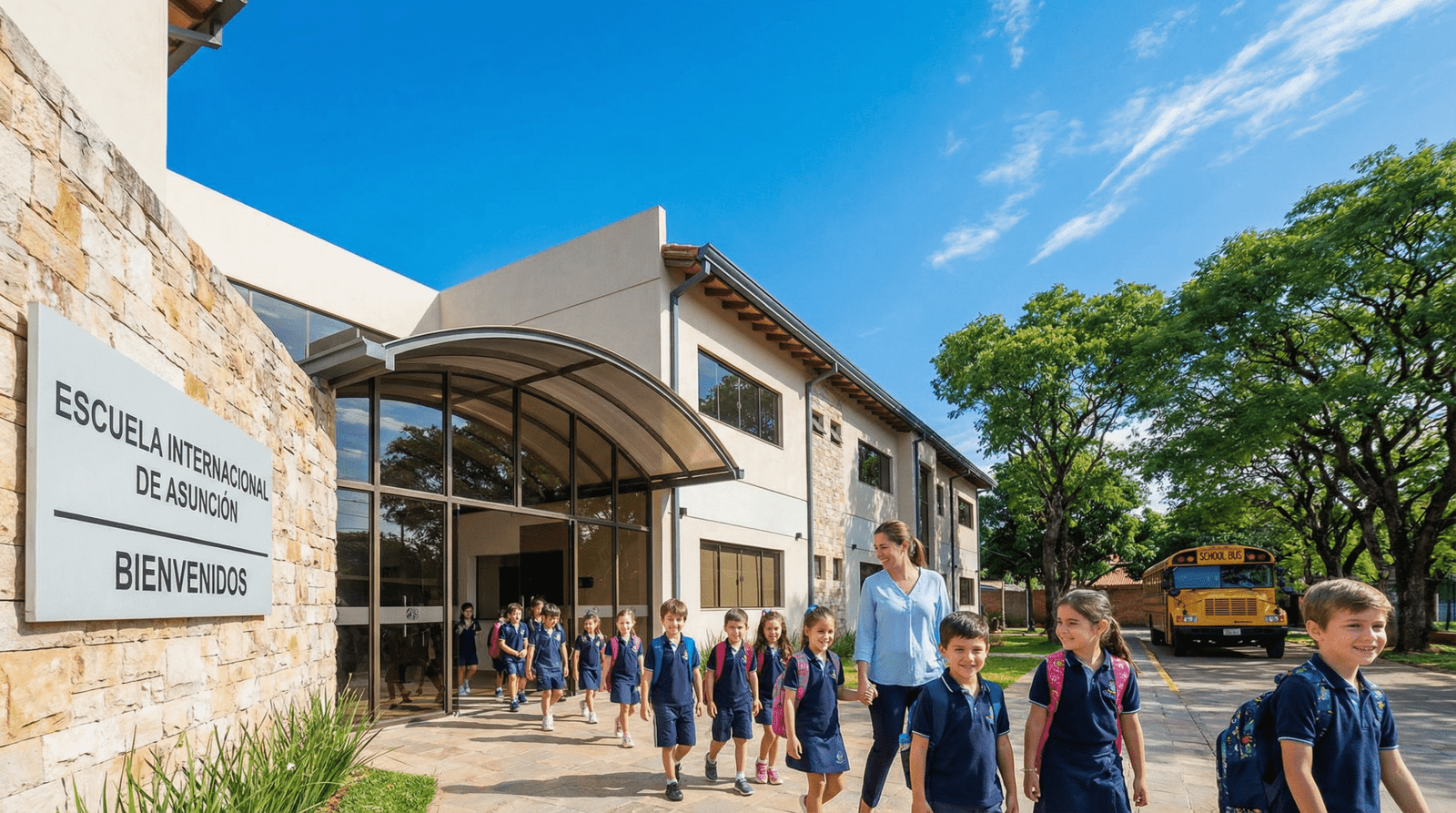
- Major Players: Colegio Goethe (German roots), Scuola Dante Alighieri (Italian roots), Colegio San José or Cristo Rey (prestigious Catholic schools), and Colegio Internacional.
3. Public Schools
- The Reality: While there are dedicated teachers in the public system, public schools in Paraguay generally suffer from severe underfunding, poor infrastructure, and frequent strikes. Furthermore, the heavy integration of Guaraní makes them practically inaccessible for non-Spanish/Guaraní speaking expat children. They are rarely a viable option for newly arrived foreigners.
Essential Logistics and Local Quirks
If you are coming from the Northern Hemisphere, prepare for some shocks.
1. The Calendar Flip: This is the biggest adjustment. Our school year runs from February to November.
- Summer Break: December, January, and part of February (the hottest months).
- Winter Break: Two weeks in July.
- Note: ASA (The American School) is the notable exception, following the northern US calendar (August–May).
2. The Uniform is Sacred Almost every school in Paraguay, public or private, requires a specific uniform. This includes dress uniforms for regular days and specific PE kits for sports days. Schools are strict about this.
3. “Transporte Escolar” Yellow school buses are rare. Most students get to school via parents dropping them off (creating massive traffic jams around 7:00 – 7:30 AM) or by hiring private “Transporte Escolar” vans that contract with families in specific neighborhoods.
Final Thoughts from a Local
If you are moving here, don’t rely solely on websites. The best way to judge a school is to visit.
Call ahead and ask for a tour. Pay attention to the atmosphere; are the kids happy? Is the campus secure? How welcoming is the administration to foreigners?
If your kids are young (under 8), they will likely adapt to a Spanish-speaking private school faster than you think. If they are teenagers without Spanish, an international school is almost certainly necessary for their academic success and mental health in the first few years.
Paraguay is a wonderful place to raise children. It is still a society that values family deeply. Once you navigate the initial hurdle of choosing a school, you will find your kids making friends quickly in a very warm environment.